
Publications:86
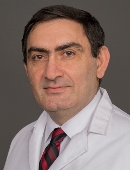
David Goukassian, MD, PhD
About Me
Dr. David A. Goukassian is a graduate of Yerevan State Medical University, class of 1985. After practicing Medicine and Dermatology for four years at the Masis Regional Hospital he went to Moscow, Russia in 1989 for post-graduate courses and completed his Ph.D. at Central Advanced Training Institute for Physicians in 1992. Between 1992 - 1994 he was the Executive Medical Director of International project on development of “Elasticity Imaging for Early Diagnosis of Breast and Prostate Cancers” at the Institute of Theoretical and Experimental Biophysics, Russian Academy of Sciences. On the wings of this project Dr. Goukassian arrived to United States in 1994 where he continued leading the R&D division of this project. In 1996 he decided to further his career in biomedical research and accepted NIH-funded post-doctoral fellowship in the fields of Aging, Genetics and Biochemistry. In 1999 he became an Instructor of Dermatology, at Boston University School of Medicine, Department of Dermatology. In 2001 he accepted a second post-doctoral fellowship in the field of Stem and Progenitor Cell Biology at the Tufts University School of Medicine. Between 1999 - 2004 he was promoted to Assistant, then Associate Professor of Dermatology and Medicine at Boston University School of Medicine. In 2004 he also joined the faculty of Cardiovascular Research Division at Tufts University School of Medicine as Associate Professor of Medicine. He was appointed as the Director of Cardiovascular Research Center at Genesys Research Institute, at Steward St Elizabeth’s Medical Center in 2012- 2015, where he was leading several major projects in the fields of Cardiovascular Space Radiobiology, Cancer Therapeutics, Stem and Progenitor Cell Biology. He continued the Cardiovascular Space Radiobiology work while at Temple University School of Medicine 2016-2018. In late 2018 he joined Cardiovascular Research Institute at Icahn School of Medicine at Mount Sinai as Professor of Medicine/Cardiology.
Dr. Goukassian has a wide-range of expertise and experience that spans from molecular and cellular biology, age-associated decline in DNA damage and repair, as well as age-associated changes in cardiac repair and regeneration with specific emphasis on studies discerning signaling cascades in the context of cardiovascular disease knockout and transgenic mouse models that mimic aging phenotype. His research is aimed at development of novel therapies based on TNF-TNFR1/p55 and -TNFR2/p75 ligand-receptor interaction, specifically – (1) development of therapies to improve post-ischemic repair, regeneration and neovascularization processes; and (2) development of universal platform therapeutics to improve stem cell and gene therapy outcomes in damaged tissues.
His most recent research focus is the field of Cardiovascular Space Radiobiology, studying cardiovascular risks for development of countermeasures during and after long-duration deep space missions. These studies are focused on using integrated physiological approaches along with genomic, proteomic and epigenetic methodologies to understand molecular mechanisms of space radiation-induced long-term cardiovascular degenerative risks, development of mouse models for evaluation of space radiation-induced Excess Relative Risks (ERR), development of predictive biomarkers for estimation of ERR, development of countermeasures for NASA’s future long-duration space missions to Moon, near Earth asteroids and Mars. These studies have significant implications for NASA’s efforts to develop heart disease risk estimates for astronauts, as well as for prevention of radiation-induced cardiovascular diseases in cancer patients receiving conventional and particle radiotherapy.
Language
English
Position
PROFESSOR | Medicine, Cardiology
Research Topics
Aging, Angiogenesis, Anti-Tumor Therapy, Antibody Development, Atherosclerosis, Cancer, Cardiovascular, Chemokines, Cytokines, DNA Repair, Endothelial Cells, Epigenetics, Epigenomics, Fibrosis, Gene Regulation, Genetics, Genomics, Growth Factors and Receptors, Inflammation, Molecular Biology, Receptors, Regeneration, Space Flight, Technology & Innovation, Translational Research, Tumor Suppressor Genes, Tumorigenesis
Education
MD, Yerevan Medical University
PhD, Central Advanced Training Institute for Physicians
Post-Doctoral Fellow, Boston University School of Medicine
Post-Doctoral, Tufts University School of Medicine
Research
Dr Goukasian's earlier research evolved from formal training in DNA damage and repair, genetics and immunology, to a recent focus on using integrated physiological approaches along with genomic, proteomic and epigenetic methodologies to understand molecular mechanisms of space radiation-induced long-term cardiovascular degenerative risks, development of mouse models for evaluation of space radiation-induced Excess Relative Risks-ERR, development of predictive biomarkers for estimation of ERR, development of countermeasures for NASA’s future long-duration space missions to Moon, near Earth asteroids and Mars. Researched cardiovascular disease risks for astronauts from low dose radiation exposures. Assisted NASA in developing heart disease risk estimates and proposed measures to prevent Earth-bound population from radiation-induced cardiovascular diseases in cancer patients receiving “standard of care” conventional and particle radiotherapy. We found, that low dose exposures of charged particles present in the space IR environment may have significant impact on CV and bone marrow system. These studies have significant implications for NASA’s efforts to develop heart disease risk estimates for astronauts, as well as for prevention of radiation-induced cardiovascular diseases in cancer patients receiving conventional and particle radiotherapy.
Publications
Selected Publications
- Cardiovascular risks and hazards associated with deep space exploration. Agnieszka Brojakowska, Malik Bisserier, Abrisham Eskandari, Vineeta Jagana, Mary K. Khlgatian, Arsen Arakelyan, Jennifer Fogarty, Jason C. Kovacic, David A. Goukassian. Communications Medicine
- Genomic Instability and Clonal Hematopoiesis in the Deep-Space Environment: The Role of Sex-Chromosome Asymmetry and High-LET Radiation. Roksana Zakharyan, Ani Stepanyan, Arpine Minasyan, Suren Davitavyan, Gisane Lazaryan, Siras Hakobyan, Agnieszka Brojakowska, Malik Bisserier, Susmita Sahoo, Shihong Zhang, Venkata Naga Srikanth Garikipati, Mary K. Khlgatian, Arsen Arakelyan, David A. Goukassian. Current Stem Cell Reports
- Space radiation promotes clonal hematopoiesis and hematologic disease upon aging in a driver gene and sex-specific manner. Megan A. Evans, Heather Doviak, Ariel H. Polizio, Jesse D. Cochran, Leslie R. Kim, Eunbee Park, Mark C. Thel, Christopher R. Xie, Ajay R. Srinivasan, Lucila Marino, Yoshimitsu Yura, Hanna Sun, Sahithi Mikkilineni, Andrew J. McKamy, George Philippos, Ana Filipa Domingues, George S. Vassiliou, Samantha C. St Jean, Eric M. Pietras, David A. Goukassian, Kenneth Walsh. iScience
Industry Relationships
Physicians and scientists on the faculty of the Icahn School of Medicine at Mount Sinai often interact with pharmaceutical, device, biotechnology companies, and other outside entities to improve patient care, develop new therapies and achieve scientific breakthroughs. In order to promote an ethical and transparent environment for conducting research, providing clinical care and teaching, Mount Sinai requires that salaried faculty inform the School of their outside financial relationships.
Dr. Goukassian did not report having any of the following types of financial relationships with industry and other outside entities during 2025 and/or 2026: consulting, scientific advisory board, industry-sponsored lectures, service on Board of Directors, participation on industry-sponsored committees, equity ownership valued at greater than 5% of a publicly traded company or any value in a privately held company. Please note that this information may differ from information posted on corporate sites due to timing or classification differences.
Mount Sinai’s faculty policies relating to faculty collaboration with industry are posted on our website. Patients may wish to ask their physician about the activities they perform for companies.